The future of hydrogen power may be pellets of aluminum and gallium. The pellets react with water to create large amounts of hydrogen. Byproducts are oxygen and aluminum oxide. This is a great way to deal with the problem of transporting hydrogen.
The aluminum oxide is apparently recyclable through electrolysis so i wonder if this is also a potential battery technology.
Full story here.
Sunday, 20 May 2007

Monday, 14 May 2007
Space solar power
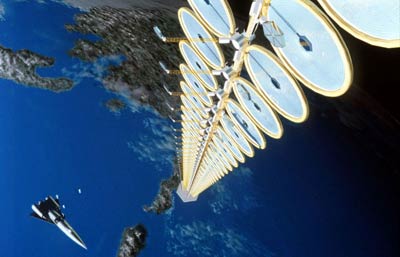 What happens if 9 billion people adopt the current standard of living for a US resident? The space review suggests that space solar panels will be needed to provide the extrapolated 102 terrawatt energy demands of the earth by 2050.
This all sounds very sci-fi, however there isn't anything beyond our current technological capabilities here so who knows?
Friday, 11 May 2007
Roof mounted solar concentrator could cut costs

I'm not sure I'm totally won over by this device. As with solar trackers in general it is based on moving parts and one thing that is good about the humble static solar panel is that there is nothing mechanical to wear out.
On the upside, it doesn't need to be pole mounted and the ultimate goal is a 75% reduction in cost on conventional panels.
Solar powered nanostructured catalyst extracts hydrogen from water
 In the same vein as yesterday's news on artificial photosynthesis. This report from the CarbonFree list explains a photo catalytic cell developed by engineers at Washington University in St Louis that splits water into hydrogen and oxygen using sunlight.
The exciting thing here is that the manufacturing process seems to be simple and easily scaled.
Thursday, 10 May 2007
Energy from light and water

The Technology Review has this interview piece with MIT professor Daniel Nocera who believes that photosynthesis may be the solution for renewable power generation and storage.
This seems like a great line of investigation. Natural photosynthesis has an energy conversion efficiency of near 100% which makes conventional solar panels running at 10 to 20% look a bit weak.
There are a few other articles on power generation from photosynthesis that I have spotted recently.
There is this fairly technical overview of an article in Nature about evidence of a quantum effect in photosynthesis that may lead to a better understanding of nature's own solar cell.
And a working model from the University of Tokyo that comes close to mimicking photosynthesis.
Saturday, 5 May 2007
Europes first commercial solar tower
It stands 40 storeys high, generates 11 Megawatts of electricity and will power 6000 homes. Not bad for a steam engine.
The BBC has some nice pictures and diagrams.
The BBC has some nice pictures and diagrams.
Energy Storage
Energy storage has been in the news a bit lately here and here and with good reason. Improved energy storage will help with issues of both base load and peak load demands.
Base load is the continous power load. It has been touted as a hurdle for solar in particular since obviously the sun doesn't shine at night.
Base load is the continous power load. It has been touted as a hurdle for solar in particular since obviously the sun doesn't shine at night.
Friday, 4 May 2007
UN claims solar success
Staying with the UN, a UN pilot project in India will be expanded to other developing nations after demonstrating that photo voltaic power can be cheaper than fossil fuels. The Australian has the full story.
Climate change 'can be tackled'
The BBC has good overview of the latest report released today by the Intergovernmental Panel on Climate Change.
The report finds that climate change must be tackled within 8 years to avoid the worst effects of climate change. Interestingly it puts the cost of these changes at less than 0.1% of the worlds GDP.
The full report is available here:
 IPCC Fourth Assessment Report summary [567KB]
The report finds that climate change must be tackled within 8 years to avoid the worst effects of climate change. Interestingly it puts the cost of these changes at less than 0.1% of the worlds GDP.
The full report is available here:
IPCC Fourth Assessment Report summary [567KB]
Thursday, 3 May 2007
Brewery Waste Fuel Cell = Power + Clean Water
Scientists at the University of Queensland yesterday unveiled a prototype fuel cell that will yield power and clean water from the sugar, starch and alcohol waste of beer brewing.
The output of a planned factory sized system is a modest 2000 watts. However this is seen more as a positive side effect of water purification than primary a renewable energy system. Australia is currently experiencing a severe nationwide drought.
The output of a planned factory sized system is a modest 2000 watts. However this is seen more as a positive side effect of water purification than primary a renewable energy system. Australia is currently experiencing a severe nationwide drought.
Aussies Make Solar Power Cell Breakthrough
The Australian is reporting a breakthrough in the solar panel manufacturing process. This is a variation on the current process to create thin film silicon cells boasting a 30% to 50% increase in efficiency.
Researchers say the new process may cause a drop in solar panel prices of 25% in a few years.
Researchers say the new process may cause a drop in solar panel prices of 25% in a few years.
Quantum Dot Recipe May Lead To Cheaper Solar Panels
Rice University scientists revealed a breakthrough method for producing molecular specks of semiconductors called quantum dots, a discovery that could clear the way for better, cheaper solar energy panels.
Subscribe to:
Posts (Atom)
